
Czech Immigration
Immigration Services in Czech Republic
Our immigration lawyer in Czech Republic helps foreign citizens who want to immigrate to Czech Republic with legal assistance and paperwork.
What do you need?
The procedure through which foreigners can immigrate to Czech Republic depends on the country of origin of such persons. Here, two categories appear: persons who are citizens of the member-states of the European Union (EU) and persons who arrive from non-EU countries.
| Quick Facts | |
|---|---|
| Entry visa requirement (from EU) | No |
Entry visa requirement (outside EU) | Yes, but there are visa exemptions for some non-EU states for short-term stays |
Types of visas available | – studies, – work, – business, – family reunification, – sports, – culture and others |
| Time frame for obtaining work visa (approx.) | 60 -120 days |
| Validity of the temporary residence permit | 1 year (certificates of temporary residence for EU citizens are available for 10 years) |
| Time frame for obtaining permanent residence (approx.) | 60 days (application in the Czech Republic); 180 days (application from abroad) |
| Investor Visa Availability | Yes |
| Sponsorship requirement | Yes, for specific types of visas (employment, family reunification) |
| Time frame for obtaining citizenship | 10 years |
| Citizenship/Residency by investment scheme availability | Residency only (long-term residence for investment: at least CZK 75 million and 20 new jobs); no citizenship by investment |
| Tax benefits for expats | – non-residents are taxed only for the income obtained in Czech Republic – foreign residents are taxed just like Czech nationals |
| Visa issuance fees | EUR 45 (for children between 6 to 11 years old), EUR 90 for the majority of foreign adult applicants, EUR 35 for certain foreign nationals (from countries with EU visa facilitation agreements, such as Armenia or Azerbaijan) |
Fee charged for the issuance of a residence permit | CZK 2,500 |
Institution in charge with the immigration formalities | Immigration services in Czech Republic are provided by the Ministry of the Interior (Department of Asylum and Migration Policy - OAMP); visas are issued by embassies under the Ministry of Foreign Affairs. |
| Right to appeal a visa refusal (yes/no) | Yes |
| When can a person make an appeal? | In a period of maximum 15 days since the visa refusal was issued. |
| Fee exemption for the issuance of a residence permit (yes/no) | No |
| When can a foreigner be exempted from fee payment? | For visa applications, foreigners can be exempted in the following cases: – based on their age (minors below 6 years old); – based on nationality (for example Moldavians, Armenians, Ukrainians, etc. do not have to pay a processing fee for the issuance of a long-term visa); – based on the purpose of the visa and nationality (Turkish nationals who have obtained a scholarship do not pay a visa processing fee); – based on family ties (family members of EU nationals are exempt from paying the Schengen visa fees); – other situations (diplomats, young foreigners with an age below 25 years old who arrive here for seminars, cultural events, etc.). |
| How long does it take to obtain a business visa? | Around 15 business days |
| Registration obligations | Foreigners must report their residency within 3 days after their arrival (applicable to those who arrive here under a Schengen visa or under a visa free regime, who do not stay in a commercial accommodation). |
| What happens in case of overstaying a visa? | Foreigners can be fined with CZK 5,000 (the rules of the Aliens Act will apply). |
| Ways to acquire citizenship | – by naturalization; – by descent; – by declaration; – for special merit |
| Requirements for citizenship by naturalization | Citizenship by naturalization is available for foreign nationals who have been living in Czech Republic for 10 years, and who are permanent residents. They must know the Czech language at a B1 level and prove they are integrated in the Czech society. |
| Fees for citizenship application | CZK 2,000 for adults and CZK 500 for minors |
| Residency rights for refugees | Refugees will receive temporary or long-term residency and they will have the same rights as those granted to other categories of residents (to work, to rent/own a home, enroll children in the public school system, benefit from medical services, etc.). |
| Law on immigration in Czech Republic | Law on the Residence of Foreigners, Asylum Act, the Czech Citizenship Act, etc. |
On what legal grounds can I relocate / immigrate to the Czech Republic?
There are a variety of reasons for which a foreigner can arrive in Czech Republic for short-term or long-term stays. In the list below, we present some of the legal grounds prescribed by the immigration law (we provide legal assistance and representation in any of the following):
- tourism and/or visiting family and friends;
- arriving here for medical treatments;
- business and investments;
- arrivals related to sports and cultural events;
- study, internship, training, scientific research;
- employment (seasonal, long-term, skilled, etc.);
- family relocation;
- volunteering, work holiday, etc.

How can we assist in Czech Republic immigration procedures?
You can rely on our immigration lawyers in Czech Republic if you need to move to Prague or any other city in the country for work purposes or for any other reason that is regulated under the Czech law. Our lawyers can offer legal advice and representation to all foreign individuals.
Some of the basic immigration services foreigners can receive are presented below:
• obtaining residence permits for short-term stays or permanent residence permits;
• assisting foreigners in employment matters in Czech Republic (applying for Blue Cards, assisting in intra-company transfers or general work permits);
• assisting foreign investors in obtaining a Czech long-term residence permit for business purposes;
• providing legal advice on family reunification programs addressed to EU or non-EU persons;
• applying for the Czech citizenship.
What are the main classes of visas issued in Czech Republic?
The legislation in Czech Republic provides 3 main classes of visas, categorized by the duration of the stay. Thus, foreigners can apply for:
- airport transit visas (necessary for the nationals of several countries, who must obtain the document if they have a connecting flight to a different destination);
- short-term stay visas, for arrivals in Czech Republic of up to 90 days;
- long-term stay visas, for arrivals of at least 90 days and up to 1 year (this category obliges the visa holder to apply for a residence permit as well).
When do I need a residence permit in Czech Republic?
This document is necessary in the case of those who will migrate in Czech Republic for a period longer than 90 days and it is mandatory for citizens outside the EU.
What are the main types of Czech residency permits?
The Czech Republic immigration law prescribes three main types of residence permits. These are:
- the temporary residence permit – it can be obtained in the case of foreigners who will live here for a period of minimum 90 days;
- the long-term residence permit, issued for those who want to stay here for a period of approximately 1-2 years;
- the permanent residence permit – this offers the right of living in Czech Republic on a permanent basis and it can be obtained after a period of staying here for minimum 5 years.
What are the processing times for a residence permit in Czech Republic?
It can take a while to obtain your residence permit, once the application file has been submitted with the help of our team. The shortest amount of time stipulated by law is 60 days. Depending on the type of residence permit you want to acquire, the following timeframes can apply:
- 90 days – for residency permits issued for skilled employment (Blue Card, family reunification as a family member of a Blue Card holder);
- 120 days – residency application of a foreigner who is a resident of another EU state;
- 180 days – applications made for permanent residency in Czech Republic;
- 270 days – applications made for residency granted on family reunification grounds.
Different timeframes can apply for applications made when the foreigner is outside Czech Republic (the list above refers to this case) and when the foreigner is already in Czech Republic. This is why we recommend you get in touch with our team for advice.
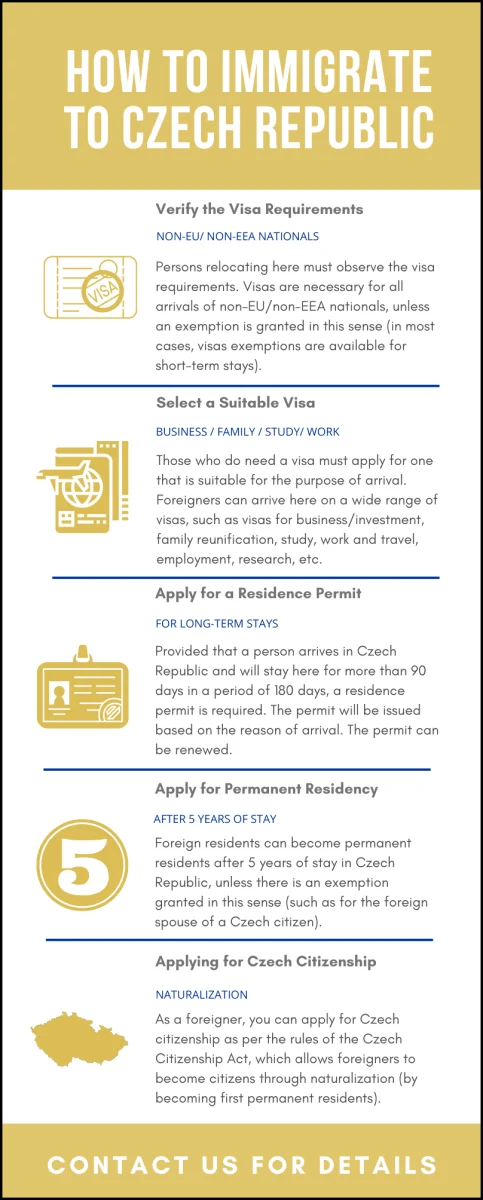
Below, you can find a short presentation on how to immigrate to Czech Republic:
What are the options for relocation to Czech Republic for investment purposes?
Foreigners can also immigrate to Czech Republic for investment purposes. In this case, they need to observe the immigration rules on the matter, which implies the issuance of a visa for investments (which is different from a business visa). You can read more about this here.
We invite foreign clients to address our team for in-depth legal counselling on any of the legal matters that have been presented in this article.